REVIEW · SYDNEY
Historic Walking Tour of Glebe
Book on Viator →Operated by Real History Walking Tours · Bookable on Viator
Glebe tells Sydney’s story in a single walk. This Historic Walking Tour of Glebe strings together Gothic churches and grand 19th-century houses, then explains how an inner suburb got shaped by both industry and old-money games. I especially like the tight, doable pace: about six stops, roughly 10 minutes each, all in around an hour.
I also love that the tour keeps costs down in the best way. Each heritage stop is listed as admission free, so your money goes to the guide and the storytelling, not extra tickets.
One consideration: it runs only on weekends in good weather. If the forecast looks miserable, you’ll need to be flexible with a different date or a refund.
In This Review
- Key highlights worth booking for
- Glebe’s churches and mansions: a history lesson you can walk
- Timing, meeting point, and the 1-hour walking rhythm
- Stop 1 at 138A Glebe Point Rd: St John’s Anglican Church
- Stop 2 at 158 Bridge Rd: Glebe Presbyterian Church and its moving life
- Stop 3 at 2 Woolley St: St James’ Catholic Church and stained-glass focus
- Stop 4 at 357 Glebe Point Rd: Bidura House’s chequered past
- Stop 5 at 244 Glebe Point Rd: Hartford House and the feel of prestige
- Stop 6 at St Scholastica’s College: the former Toxteth Park House
- What you’ll learn about Sydney’s mix of industry and old money
- Practical value: price, group size, and getting your money’s worth
- Who should book this walking tour (and who might skip)
- Should you book the Historic Walking Tour of Glebe?
- FAQ
- How much does the Historic Walking Tour of Glebe cost?
- How long is the tour?
- What day and time does it run?
- Where do I meet and where does the tour end?
- Is admission included for the buildings on the route?
- What’s the group size?
- Are pets or service animals allowed?
- What happens if the weather is bad?
- Can I cancel for a refund?
Key highlights worth booking for
- Six heritage stops in one easy loop with about 10 minutes at each place
- Free-entry locations at every church and heritage house on the route
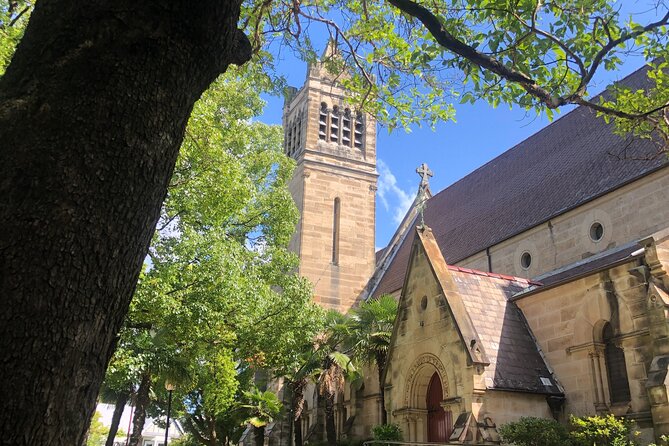
- Churches with big architectural personalities—Gothic revival sandstone and stained-glass details
- A real “class and industry” story behind Glebe’s Edwardian and Victorian buildings
- Small group size (max 30) so you can actually hear the guide
- Ends at St Scholastica’s College, right where the best final streetscape shows up
Glebe’s churches and mansions: a history lesson you can walk
Glebe is one of those Sydney suburbs where the streets already feel like a timeline. You get Victorian mansions and church buildings close together, which makes it easy to see how different kinds of power lived side by side.
What makes this tour work is the way the guide connects the architecture to the social mix. Glebe’s character comes from the push and pull of workaday industry and the outsize fun of Sydney’s ultra rich. When you walk from one landmark to the next, that contrast stops being an abstract idea and becomes something you can point at: spires, stained glass, grand residences, and then the later, more complicated uses of those same spaces.
You can also read our reviews of more walking tours in Sydney

Timing, meeting point, and the 1-hour walking rhythm
This tour operates every weekend on Saturday mornings. The start time is 10:00 am, with a meeting point at 140 Glebe Point Rd, Glebe NSW 2037. The tour finishes at the front of St Scholastica’s College (on Avenue Rd, Glebe).
Expect a one-hour experience overall (approx.), and a straightforward flow: walk, pause, hear the story, then move on. Because each stop is paced at about 10 minutes, it’s perfect if you want history without turning the whole morning into a long slog.
A practical note: the tour is listed as requiring good weather. If you’re planning for peak summer showers or winter wind, bring a light rain layer and be ready for the tour to shift if conditions are poor.
Stop 1 at 138A Glebe Point Rd: St John’s Anglican Church
St John’s Anglican Church is the kind of building that instantly grabs the skyline. It’s a massive Gothic Revival structure, with a towering spire and impressive grounds that make Glebe Point Rd feel dramatic even before you learn a single fact.
This first stop matters because it sets the tone: a church wasn’t just for worship—it was also a visible sign of community importance. The guide’s job here is to help you read the building like a page. Look for the way the spire dominates nearby streets and the way the church’s scale signals influence in the neighborhood.
Also, this stop is listed as admission free, so you can focus on the guide’s explanations without worrying about additional entry fees.
Stop 2 at 158 Bridge Rd: Glebe Presbyterian Church and its moving life
If St John’s gives you the big Gothic moment, Glebe Presbyterian Church brings a different kind of presence. It’s a dominating sandstone building, and the standout detail here is its “nomadic life” — the idea that the church’s life and location weren’t fixed in the simple, permanent way you might assume.
This is a smart second stop because it changes your perspective. You start noticing that heritage buildings aren’t always static monuments. Sometimes they get repurposed, moved, or reshaped by changing needs. In a suburb like Glebe, where industry and wealth tugged the neighborhood in different directions, that flexibility makes sense.
Like the other stops, this church is listed as free to enter, so you’ll only be paying for the guided portion—this is where the tour feels like value.
Stop 3 at 2 Woolley St: St James’ Catholic Church and stained-glass focus

St James’ Catholic Church at 2 Woolley St is where I’d point you if you love details you can actually see up close. The church sits in a complex of differing heritage architectural styles, and the highlight is the stained glass.
Stained glass can be decorative, but it’s also storytelling in another form. On a walking tour like this, the guide helps you connect the artwork to the setting around it—so you’re not just looking at pretty windows. You’re understanding why they mattered in a community and what they were meant to communicate.
This stop is also admission free, and it gives you a nice pause point after the heavier “who moved what” story of the previous church.
You can also read our reviews of more historical tours in Sydney

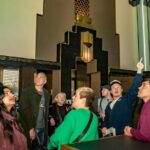

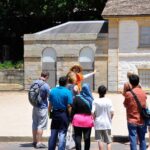
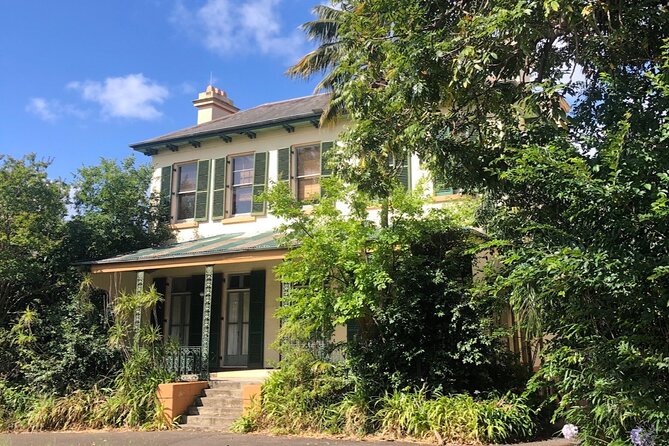
Stop 4 at 357 Glebe Point Rd: Bidura House’s chequered past
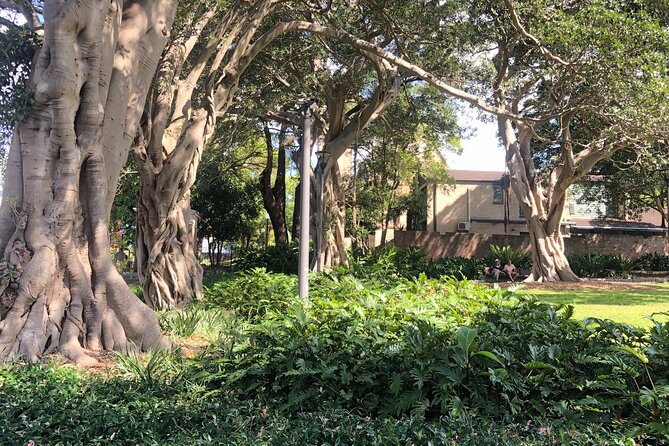
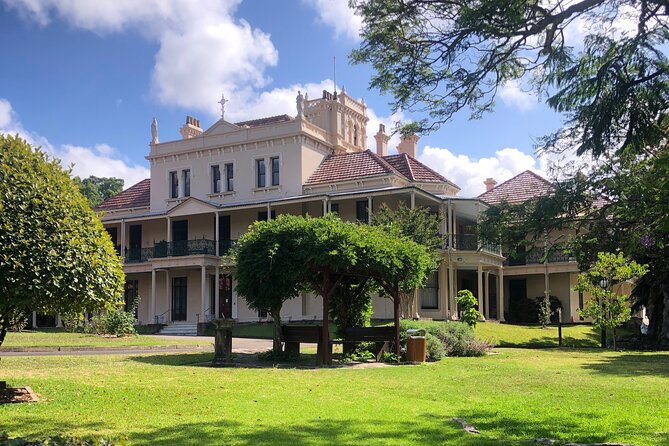
Then you shift from churches into residential grandeur with Bidura House. This is an 1860s gentleman’s residence, and the reason it’s on the route is the chequered past.
The tour frames Bidura House as a building that changed roles over time. At different points, it went from being a prominent mansion to becoming a massive children’s detention centre. That’s heavy material, but it’s precisely the kind of history you can’t get from a simple street-view scan.
I like this stop because it forces a useful mental connection: architecture doesn’t just reflect wealth. It also reflects what a society chose to do with power and space later on. Standing in the presence of a former residence while hearing how its function changed makes the whole “industry vs. privilege” theme click.
Stop 5 at 244 Glebe Point Rd: Hartford House and the feel of prestige
Hartford House is one of Glebe’s more elaborate mansions, and it’s included for a clear reason: it’s an example of one of the suburb’s most prestigious houses.
This stop helps balance the tour. After the emotional weight of Bidura House, you get back to the visual language of status—scale, design ambition, and the feeling of a home built to impress. You don’t have to be an architecture nerd to appreciate the contrast, because the guide keeps it practical: what you’re looking at, what that style usually meant, and why it ended up in Glebe.
Because each stop is listed as admission free, you can take your time here without turning it into another ticketed attraction.
Stop 6 at St Scholastica’s College: the former Toxteth Park House
The final stop is at St Scholasticas College, tied to the former Toxteth Park House. This is described as the most impressive house in Glebe, and it’s linked to one of the richest families in Sydney.
This ending location is also a good design choice for the tour itself. Ending on the front of St Scholastica’s College means you finish in a place that still feels built for importance—so the morning doesn’t end with just another street corner.
If you want to understand Glebe fast, this is the key idea: Toxteth Park House anchors the “ultra rich” side of the suburb’s story, while the earlier churches and Bidura House complicate the idea of prosperity by showing how communities and buildings evolved.
What you’ll learn about Sydney’s mix of industry and old money
One of the best parts of this tour is how it treats Glebe as more than a pretty set of buildings. The suburb’s development came from industry mixed with the frivolous activities of Sydney’s ultra rich—two forces that didn’t neatly separate.
So when you look at a church’s spire first, then a sandstone building with a moving life, then mansion spaces used in later, more difficult ways, you start seeing a pattern. You realize the neighborhood wasn’t created by one simple class group. It was shaped by people with very different priorities, needs, and power.
That’s why the guided portion matters. Without context, you might see “old churches” and “big houses.” With a good guide, you’re learning how Sydney worked: where influence showed up, how buildings adapted, and why certain architecture ended up in this particular inner suburb.
Practical value: price, group size, and getting your money’s worth
The price is $28.69 per person for an experience that’s about an hour long. For Sydney, that’s a reasonable figure when what you’re paying for is guided interpretation of multiple heritage buildings, not just a single landmark photo stop.
You’ll also appreciate the small-group limit: maximum 30 travelers. With that size, the walk stays organized, and you’re less likely to end up craning your neck for every story.
This is a mobile-ticket experience, and it runs close to public transportation. If you’re already in the Inner West for the morning, it slots in easily.
One small downside on value: it’s not a coffee tour. Coffee or tea isn’t included, so if you want to grab something afterward, plan a stop near Glebe Point Rd or along the nearby streets.
Who should book this walking tour (and who might skip)
This tour suits you if you like:
- Short guided history that doesn’t eat your whole day
- Architecture you can see close up—especially churches and grand residences
- Getting context for a neighborhood instead of collecting random facts
It may not be for you if:
- You want a long, slow-paced stroll with frequent breaks
- You dislike weather-dependent plans (the tour needs good conditions)
Should you book the Historic Walking Tour of Glebe?
I’d book it if you want a quick, high-impact way to understand Glebe. For the price, you get multiple heritage stops that are listed as admission free, a focused route that fits into a morning window, and a story that connects architecture to real social change.
It’s also a great choice if you’ve been to Sydney before and want something less obvious than the major headline sights. Glebe doesn’t require a car, doesn’t need multiple ticketed venues, and still feels like you’re stepping into the inner workings of how the city grew.
If the weather is looking shaky, check the forecast and keep your plans flexible—this tour depends on it.
FAQ
How much does the Historic Walking Tour of Glebe cost?
It costs $28.69 per person.
How long is the tour?
The tour is approximately 1 hour.
What day and time does it run?
It runs every weekend on Saturday mornings, starting at 10:00 am.
Where do I meet and where does the tour end?
You meet at 140 Glebe Point Rd, Glebe NSW 2037, and finish at the front of St Scholastica’s College on Avenue Rd, Glebe NSW 2037.
Is admission included for the buildings on the route?
The tour listings for each stop show admission ticket free for the heritage sites.
What’s the group size?
The tour has a maximum of 30 people.
Are pets or service animals allowed?
Service animals are allowed, and pets are welcome.
What happens if the weather is bad?
The experience requires good weather. If it’s canceled due to poor weather, you’ll be offered a different date or a full refund.
Can I cancel for a refund?
Yes. You can cancel up to 24 hours in advance for a full refund. If you cancel less than 24 hours before the start time, the amount paid isn’t refunded.
You Might Also Enjoy



More Walking Tours in Sydney
More Tours in Sydney
- Blue Mountains Small-Group Tour from Sydney with Scenic World,Sydney Zoo & Ferry
★ 5.0 · 3,709 reviews



More Tour Reviews in Sydney
- Blue Mountains Small-Group Tour from Sydney with Scenic World,Sydney Zoo & Ferry
★ 5.0 · 3,709 reviews